
Dog Chip With Tracker: What Every Dog Owner Should Know

If you are searching for a dog chip with tracker, you probably want a simple way to keep your dog safe and find them quickly if they ever go missing. Modern pet technology offers several ways to protect dogs, including implanted microchips, GPS trackers, Bluetooth tracking devices, and traditional identification tags.
However, there is one important fact to understand before choosing a device: a standard dog microchip cannot track your dog’s live location. It identifies your dog when a veterinarian, animal shelter, or another person scans it. To see where your dog is on a map, you need a separate tracking device.
The good news is that you can combine these technologies to improve your dog’s safety. This guide explains how dog chips and trackers work, the differences between them, their benefits and limitations, and how to choose the right option for your pet.
What Is a Dog Chip With Tracker?
A dog chip with tracker usually refers to a pet identification microchip and a tracking device used together. Some owners also use the phrase when searching for an implanted chip that can show their dog’s location through a smartphone.
These are two different technologies.
A microchip is a tiny electronic identification device implanted under your dog’s skin. It carries a unique identification number that can be linked to your contact information through a registry.
A GPS dog tracker is a small electronic device attached to a collar or harness. Depending on the model, it can use GPS and a mobile network to show your dog’s location in an app.
A microchip helps someone identify your dog after finding them. A GPS tracker can help you locate your dog yourself.
For example, imagine your dog escapes through an open gate while you are working in the garden. A GPS tracker may show their location, allowing you to start looking for them. If the tracker falls off or its battery runs out, an implanted microchip can still help a shelter identify your dog if someone finds them and has the chip scanned.
That is why these technologies are best viewed as complementary tools rather than replacements for one another.
ALSO READ:Can Dogs Get Colds? Symptoms, Treatment and Care
Can a Dog Microchip Track Your Dog’s Location?
No. A standard implanted dog microchip cannot provide real-time location tracking.
Microchips do not contain GPS receivers, batteries, or the equipment needed to transmit location information over long distances. They remain inactive until a compatible scanner is brought close to the chip. The scanner reads the unique identification number, which can then be used to look up the registered owner.
A microchip cannot:
- Show your dog’s location on a smartphone map.
- Tell you which street your dog is walking on.
- Send an alert when your dog leaves your garden.
- Track your dog’s movements throughout the day.
- Help you follow your dog remotely using GPS satellites.
This does not mean microchipping is unnecessary. It serves a different purpose and can be extremely valuable when a dog becomes lost.
If your main goal is to locate your dog when they run away, look for a dedicated GPS tracker. If your goal is permanent identification, microchipping is the appropriate option.
For the most complete protection, consider using both.
How Does a Dog Microchip Work?
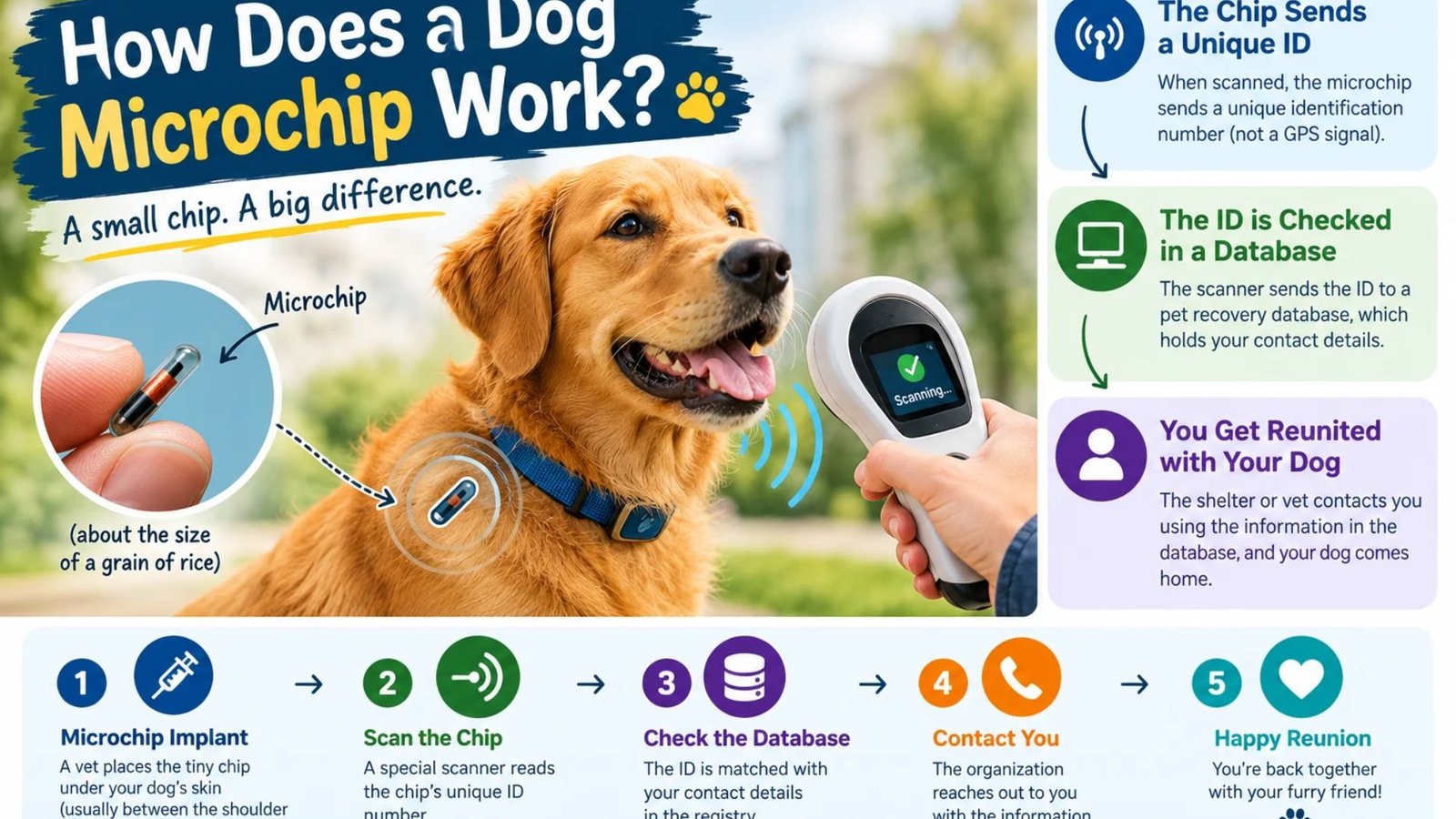
A pet microchip is a small electronic transponder enclosed in a protective material, usually glass. It is approximately the size of a grain of rice and is commonly implanted beneath the skin between the shoulder blades.
The process is straightforward.
The Microchip Is Implanted
A veterinarian or another appropriately trained professional inserts the microchip beneath your dog’s skin using a special needle. The procedure is generally quick and may cause brief discomfort similar to an injection.
Your veterinarian can advise you about the best time to have your dog microchipped, particularly if your pet is young, very small, or has a medical concern.
The Chip Receives a Unique Identification Number
The chip contains a unique identification number. It does not normally store your address, telephone number, or full owner profile directly.
Instead, the identification number is associated with a record in a microchip registry.
A Scanner Reads the Chip
If your dog becomes lost and is taken to a veterinary clinic or animal shelter, staff can scan the dog for a microchip.
The scanner reads the identification number, which can then be used to identify the relevant registry and help contact the owner.
Your Contact Details Help Bring Your Dog Home
Microchipping works best when your contact information is registered correctly and kept up to date.
If you change your phone number, move to another address, or adopt a dog from someone else, check the registration details. An implanted chip with outdated contact information may make reuniting with your dog more difficult.
A microchip is therefore a long-term identification tool, not a substitute for an active tracking device.
How Does a GPS Dog Tracker Work?
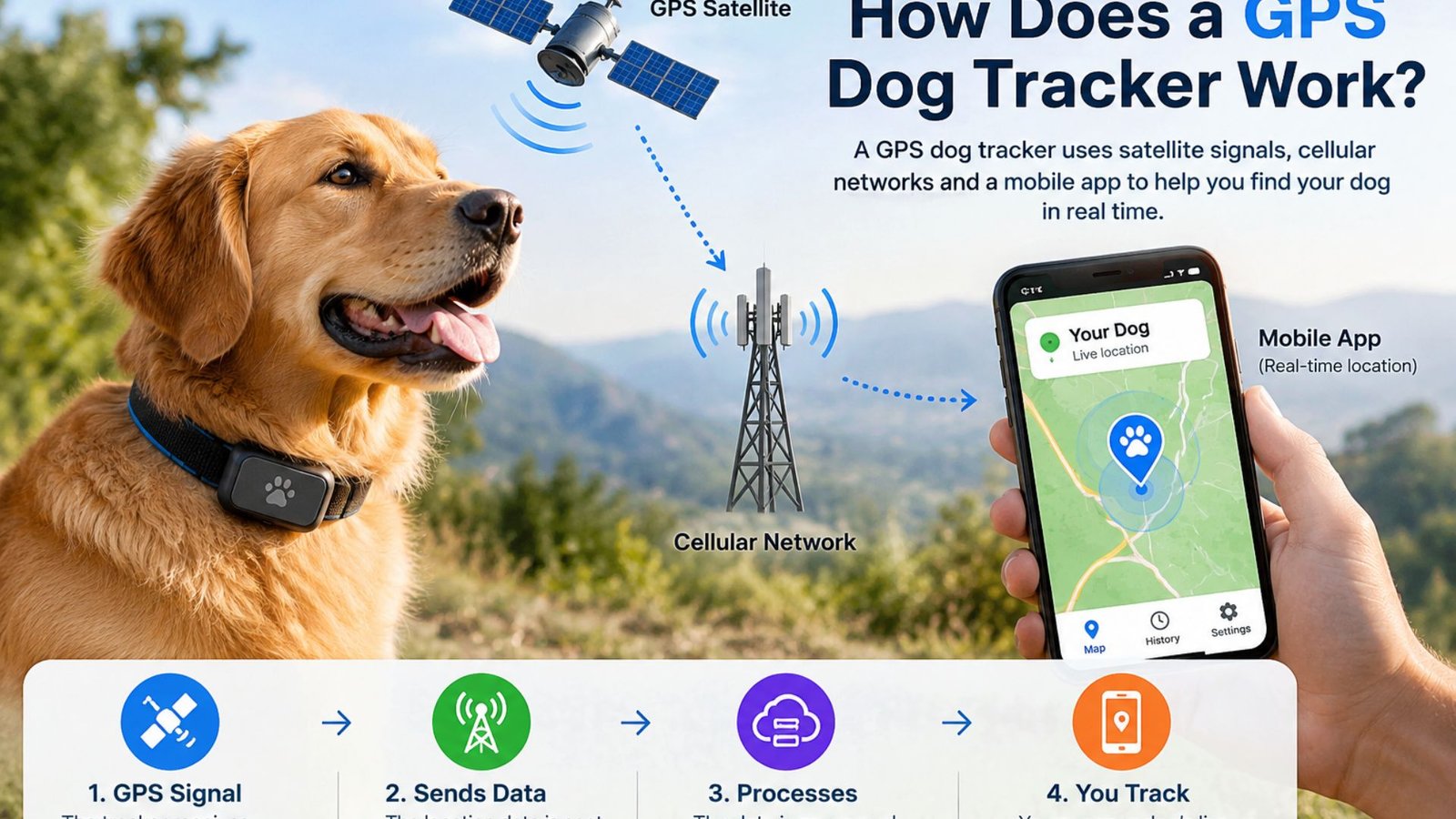
A GPS dog tracker is designed to help you locate your dog while they are wearing the device.
Most GPS trackers combine satellite positioning with a way to send location information to your phone, often through a cellular connection and a companion app. Some models use other technologies or combinations of location systems.
Here is how a typical GPS tracker works.
GPS Determines the Location
The device receives signals from GPS satellites to estimate its position. The tracker then uses its communication system to send that information to the associated app.
The app may display your dog’s current or most recently reported location on a map.
The App Shows Your Dog’s Position
Once the tracker sends location data, you can open the app to see where your dog is. Depending on the product, you may also be able to review location history or activate more frequent updates.
The speed and accuracy of these updates vary between devices and conditions. Buildings, dense trees, poor cellular coverage, and other environmental factors can affect performance.
Some Trackers Provide Escape Alerts
Certain GPS trackers let you create a virtual boundary around your home or another location. This feature is often called a geofence.
If your dog crosses the boundary, the app may send you an alert. This can be useful for dogs that are curious, adventurous, or prone to escaping.
However, alerts are not guaranteed to arrive instantly. The device needs sufficient battery power, a working connection, and the relevant feature enabled.
The Tracker Needs Power
Unlike a standard implanted microchip, a GPS tracker uses a battery. You must recharge it or replace its batteries according to the manufacturer’s instructions.
Some trackers also require a paid subscription for cellular connectivity and location services.
Before purchasing one, check the battery life, charging requirements, coverage in your area, and any ongoing fees.
Dog Microchip vs GPS Tracker: What Is the Difference?
Understanding the difference between these two technologies will help you choose the right equipment for your dog.
Implanted microchip
Permanent identification
- Implanted beneath the skin.
- Does not need a battery.
- Cannot display live location.
- Helps identify your dog after someone finds and scans them.
GPS dog tracker
Location tracking
- Usually attached to a collar or harness.
- Needs a charged battery.
- Can report location through a compatible app.
- May include escape alerts and location history.
ID tag
Quick contact
- Attached to a collar.
- Requires no battery or app.
- Can display your phone number.
- Helps someone contact you without scanning a chip.
Each option solves a different problem. An ID tag offers a simple way to contact you, a microchip provides permanent identification, and a GPS tracker helps you locate your dog.
For many owners, using all three offers better protection than relying on any one of them.
Types of Dog Tracking Devices
Not every device marketed for pet tracking works in the same way. Choosing the correct type depends on where your dog spends time, how far they might roam, and how quickly you need location updates.
GPS Collar Trackers
GPS collar trackers are often the most suitable option for owners who want to locate a dog that escapes or wanders away.
They can show location information through a mobile app, and some offer live tracking, virtual boundaries, and location history.
They are particularly useful for dogs that spend time outdoors, accompany their owners on hikes, or have a habit of slipping out through open doors.
The main drawbacks are charging, device size, possible subscription costs, and dependence on communication coverage.
Bluetooth Trackers
Bluetooth trackers are designed primarily for finding nearby objects. Some can help locate a collar or pet when the device is within Bluetooth range.
Their performance depends on the model and surrounding environment. They generally should not be treated as a replacement for a dedicated GPS tracker when a dog could run a long distance away.
Network-Based Item Finders
Some item finders use a network of compatible nearby phones or devices to help report a tag’s location.
They may be useful in places where many participating devices are present, but updates can be limited in rural areas, forests, or other places with few nearby devices.
Before choosing one for a dog, check whether the manufacturer specifically supports pet tracking and whether its limitations suit your dog’s lifestyle.
Radio-Frequency Trackers
Some pet tracking systems use radio signals rather than conventional GPS. Depending on the product, they may work well for particular activities, such as tracking dogs in remote areas or during field work.
Their range, equipment requirements, and operating method vary. Make sure you understand how the system works before relying on it to recover a missing dog.
Which Type Is Best?
For owners who want to see their dog’s position on a smartphone map over a broad area, a dedicated GPS tracker is usually the most relevant choice.
For close-range searching, a Bluetooth device may be useful in the right conditions. An implanted microchip remains important for permanent identification regardless of which tracking technology you choose.
Benefits of Using a Dog Chip and Tracker Together
Combining an implanted microchip with an appropriate tracking device provides several practical benefits.
Better Protection If Your Dog Goes Missing
A GPS tracker may help you find your dog soon after they escape. If the tracker is lost, damaged, or out of battery, a registered microchip can still help someone identify your dog if they are found.
Neither method guarantees recovery, but each provides a different route to getting your pet home.
More Confidence During Walks
Some owners feel more confident taking their dogs to parks, trails, campsites, or other unfamiliar places when they have a suitable GPS tracker.
A tracker may help you respond faster if your dog slips their lead or runs after something unexpected.
It should not replace a secure lead, appropriate supervision, or reliable recall training.
Useful Escape Notifications
A GPS tracker with a geofence feature may alert you when your dog leaves a designated area.
This can be useful if your dog has previously escaped from your garden or has a tendency to follow interesting smells beyond the property.
Keep in mind that virtual boundaries are software features, not physical barriers. A fence, secure gate, and careful supervision remain important.
Easier Identification After Adoption
If you adopt a dog, checking their microchip status and registration can help establish permanent identification. A GPS tracker can then be added if you need location monitoring.
Ask the previous owner, rescue organisation, or veterinarian to help confirm that the chip details are correctly transferred to you.
Long-Term Peace of Mind
No tracking device removes every risk, but combining identification, tracking, training, and safe handling can make a sensible difference.
The goal is not to depend on technology alone. It is to have several ways to prevent a dog from becoming lost and improve the chances of bringing them home if they do.
How to Choose the Best Dog Chip With Tracker
Choosing a tracking solution starts with understanding your dog’s needs. A small dog living in an apartment may need different equipment from a large dog that explores fields or wooded trails.
Consider the following factors before buying a device.
Your Dog’s Size and Comfort
Choose a tracker that fits your dog’s collar or harness securely without restricting movement. A bulky device may be uncomfortable for a small breed, while an active, larger dog may need a more rugged attachment.
Check the manufacturer’s recommended weight range and ensure the attachment is secure.
Tracking Accuracy
Look for clear information about location accuracy, update frequency, and performance in areas with weak mobile coverage.
A map marker is an estimate of the device’s location, not a guarantee of your dog’s exact position. Check how often the device updates and whether live tracking is available.
Battery Life
Battery life can vary significantly depending on the device, settings, signal conditions, and frequency of location updates.
If your dog regularly goes on long walks or outdoor adventures, consider a model that offers suitable battery life and convenient charging.
Make charging part of your routine rather than waiting until the battery is nearly empty.
Subscription Fees
Some GPS trackers require a monthly or annual subscription for mobile connectivity and location services. Others use different communication methods or have different payment arrangements.
Check the full cost before purchasing, including the initial device price, subscription fees, replacement accessories, and any additional services.
Water Resistance and Durability
Dogs may encounter rain, mud, puddles, and rough outdoor conditions. Look for a device with a clearly stated water-resistance rating that suits your dog’s activities.
Water-resistant does not necessarily mean waterproof. Follow the manufacturer’s guidance about swimming, cleaning, and exposure to water.
App Compatibility and Coverage
Confirm that the tracker works with your smartphone and is supported in your country.
For owners in the USA and UK, check cellular coverage in the locations where the dog will be using the device. A tracker that works well in a city may perform differently in remote countryside.
Privacy and Data Controls
Some tracking apps store location history and account information. Review the manufacturer’s privacy policy, account security options, and data-sharing settings before registering.
A good choice should be practical, comfortable, reliable for your needs, and affordable to maintain.
How Much Does a Dog Chip With Tracker Cost?
The cost depends on whether you mean an implanted microchip, a GPS tracking device, or both.
An implanted microchip is generally a one-time veterinary expense, although registration or other service fees may apply depending on the provider.
A GPS tracker requires purchasing a device, and some models also have recurring subscription costs.
An ID tag is generally a simple, lower-cost addition to your dog’s collar.
Prices vary by country, veterinary clinic, brand, and features, so it is best to compare current prices rather than assume every tracker costs the same.
When comparing options, calculate the total cost over a year or two. A cheaper tracker with expensive monthly fees may cost more over time than a higher-priced model with a more suitable service plan.
If your budget is limited, prioritise a registered microchip and a clearly readable ID tag. Add a GPS tracker when you can choose one that meets your needs without creating financial pressure.
Is a Dog Microchip Safe?
Microchipping is a routine veterinary procedure and is generally considered safe. The insertion process may cause brief discomfort, and complications such as infection are possible but uncommon. Your veterinarian can explain the risks and what to expect for your individual dog.
The microchip is designed to remain under the skin for long-term identification. It does not need regular charging or the same maintenance as a GPS tracker.
After implantation, ask your veterinarian to scan the chip and confirm that it can be read. Keep the registration information current and ask whether your dog should have the chip checked during routine veterinary visits.
A GPS tracker, by contrast, is an external electronic device. Check its attachment regularly, keep it charged, and inspect the collar or harness for damage.
Neither device should cause your dog ongoing discomfort. If the implanted area becomes swollen or painful, or an attached tracker causes skin irritation, contact your veterinarian and stop using any uncomfortable equipment until you have appropriate advice.
Are Dog Tracking Devices Legal in the USA and UK?
Pet identification and tracking requirements can differ depending on the country and circumstances.
In the UK, dogs generally must be microchipped and registered in accordance with applicable regulations, subject to relevant exceptions. Owners should also ensure their contact details are up to date.
In the USA, requirements can vary by state, locality, travel situation, and other circumstances. Check the applicable rules with your veterinarian or local animal authority.
A GPS tracker does not replace any legally required microchip or other identification.
If you travel internationally with your dog, check the destination country’s current microchip, vaccination, documentation, and identification requirements well before departure. Some travel rules specify particular microchip standards.
What Should You Do If Your Dog Goes Missing?
Even with a microchip and GPS tracker, it is helpful to have a plan in advance.
Check the Tracker App
If your dog is wearing a GPS tracker, open the app and check the most recent location. Look at the time of the last update as well as the map marker.
If the location has not updated, the device may have a low battery, weak signal, or connectivity problem. Do not assume an old location is where your dog still is.
Search Safely
Start by checking nearby safe areas and contacting people who may have seen your dog. If the tracker indicates a dangerous location, such as a busy road, avoid putting yourself or your dog at risk.
Ask nearby people for help where appropriate, and contact local animal control or animal rescue services if necessary.
Contact Local Shelters and Veterinary Clinics
Tell nearby shelters, veterinary clinics, and rescue organisations that your dog is missing. Provide a recent photograph, your dog’s description, and your contact details.
If your dog is found and scanned, a registered microchip can help the person or organisation identify you.
Confirm Your Microchip Registration
Check that the microchip is registered in your name and that the contact information is correct.
If you have not checked the details recently, confirm the registry and update your information as soon as possible.
Share Accurate Information
Post a recent photograph and clear identifying details in appropriate local lost-pet groups. Include the area where your dog was last seen and a reliable way to contact you.
Be cautious about anyone asking for money before providing credible information about your dog. Verify claims carefully.
Preparation matters. Keep a recent photograph, microchip number, veterinary contact details, and tracker account information somewhere you can access quickly.
Common Mistakes to Avoid
Even good equipment can fail to help when it is not maintained or used correctly.
- Assuming a microchip provides GPS tracking: A standard implanted chip only identifies your dog when scanned.
- Forgetting to register the microchip: The identification number needs to be linked to current contact information.
- Leaving the tracker uncharged: A dead battery can prevent location updates.
- Ignoring subscription requirements: Some devices stop providing certain tracking services if a subscription expires.
- Choosing an unsuitable device: A tracker that is too heavy, uncomfortable, or poorly secured may not suit your dog.
- Relying on a tracker instead of supervision: Technology cannot prevent every escape or guarantee your dog’s recovery.
- Failing to test the app: Learn how to view location updates and alerts before an emergency occurs.
Reviewing these details regularly helps ensure that your equipment is ready when you need it.
Is a Dog Chip With Tracker Worth It?
For many dog owners, using a registered microchip alongside a suitable GPS tracker is a sensible investment in their pet’s safety.
The microchip offers permanent identification without requiring a battery. The GPS tracker may help you locate your dog while they are wearing it. A visible ID tag provides another quick way for someone to contact you.
Your ideal setup depends on your dog’s behaviour, environment, lifestyle, and your budget. Dogs that frequently escape or accompany their owners on outdoor adventures may benefit particularly from GPS tracking. Even dogs that stay indoors most of the time can benefit from permanent identification because accidents and escapes can happen unexpectedly.
Remember that no device guarantees that a lost dog will be recovered. Secure doors and gates, appropriate leads, reliable recall training, current identification, and responsible supervision remain essential.
Conclusion
A dog chip with tracker can mean a combination of permanent identification and location tracking, but these technologies perform different jobs. An implanted microchip does not contain GPS and cannot show your dog’s live location. A dedicated GPS tracker can report location through a compatible app, provided the device has power and the required connectivity.
For the strongest practical approach, consider a registered microchip, a visible ID tag, and a GPS tracker suited to your dog’s size and lifestyle. Keep all contact information current, maintain the tracker’s battery, and learn how its app works before you need it.
These simple steps can help you prepare for an unexpected escape and improve your chances of reuniting with your dog.
ALSO READ:Dog Breeds That Start With B: Best Breeds for Every Home
FAQs
Can I track my dog using its microchip number?
No. A microchip number identifies your dog in a registration system, but it does not provide GPS coordinates or live location updates. You need a separate tracking device to locate your dog on a map.
Is there an implanted GPS microchip for dogs?
Standard pet microchips are identification devices, not GPS trackers. They do not have the battery and communication systems required for live tracking. A GPS tracker is normally attached to a collar or harness.
Can a GPS tracker replace my dog’s microchip?
No. A GPS tracker can help locate your dog while the device is working and attached. A registered microchip provides permanent identification if your dog is found and scanned. They serve different purposes.
What is the best tracker for a dog that often runs away?
A dedicated GPS collar tracker with location updates and escape alerts may be a suitable option. Compare battery life, coverage, accuracy, subscription fees, and comfort before buying. Also work on recall training and secure containment to reduce escape risks.
Does my dog need both a microchip and a GPS tracker?
A registered microchip and a visible ID tag are valuable identification tools. A GPS tracker is an additional option if you want to monitor your dog’s location. Using all three provides complementary protection, although no combination can guarantee recovery.
Related Post

Dog Breeds That Start With B: Best Breeds for Every Home
If you are searching for a dog breed that starts with B, you have plenty [...]
Beef Trachea for Dogs: Benefits, Risks, Nutrition, and Safe Feeding Guide
Beef trachea for dogs has become a popular choice among pet owners looking for natural [...]