Tortoiseshell Siamese: Colors, Personality and Care
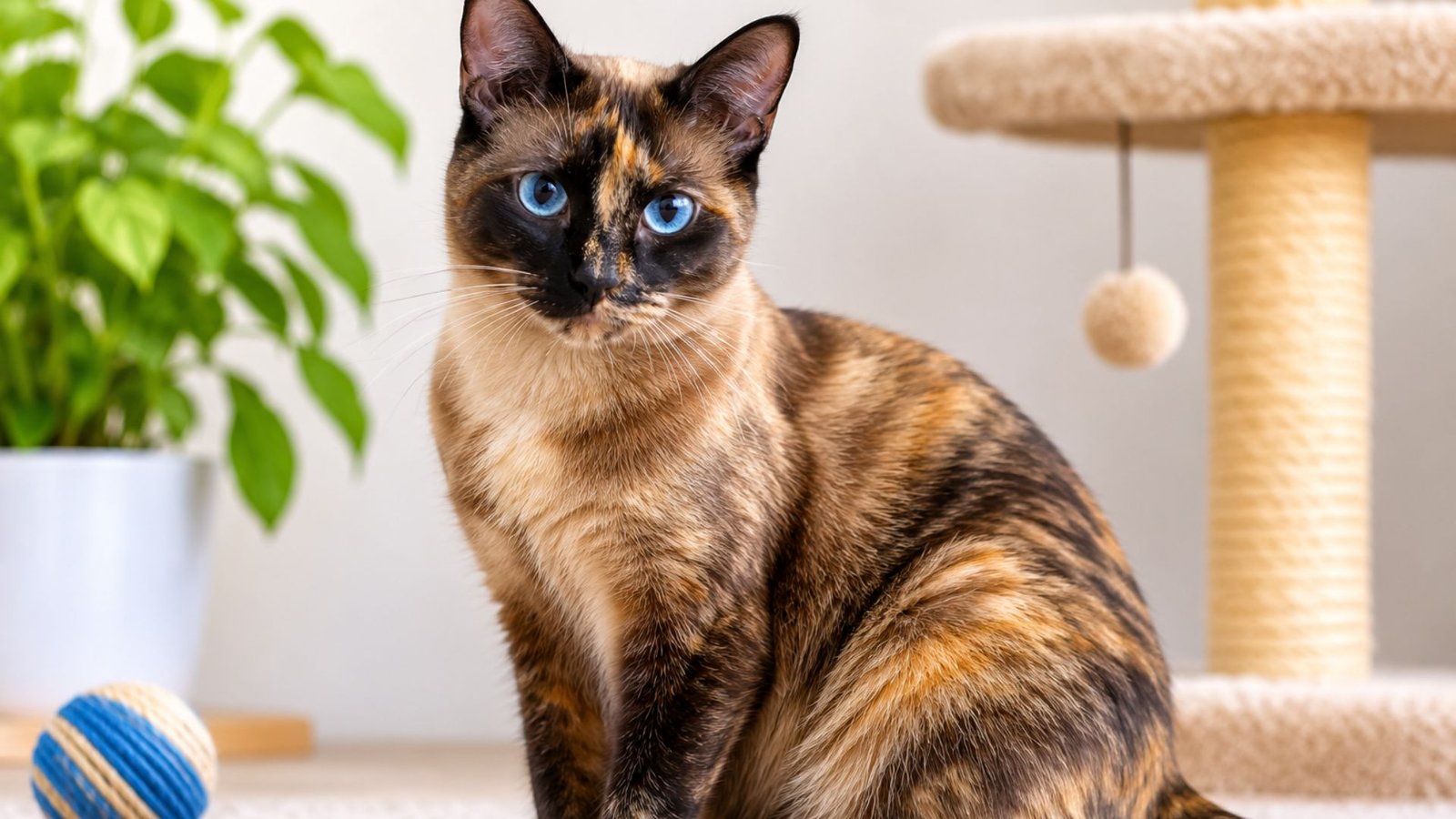
A tortoiseshell Siamese is a beautiful cat with the distinctive color-point pattern of a Siamese and a mix of dark and reddish coat colors. These cats are often called tortie-point Siamese, and their unusual markings make them especially eye-catching.
If you are thinking about adopting one, or simply want to understand what makes this cat special, this guide explains its appearance, genetics, personality, care needs, and health.
What Is a Tortoiseshell Siamese?
A tortoiseshell Siamese is a Siamese-type cat with a tortoiseshell color pattern. Instead of having just one color on its darker points, it has a mixture of colors, usually dark brown or black with orange or cream.
The term “tortoiseshell” describes the coat pattern, while “Siamese” refers to the breed or color-point appearance. The two terms describe different features of the cat.
A tortie-point Siamese typically has:
- A lighter-colored body with darker markings on the face, ears, legs, and tail.
- A mixture of dark and orange-based colors within those darker areas.
- Blue eyes, which are characteristic of the Siamese color-point pattern.
- A short, smooth coat that is easy to maintain.
The exact appearance varies from cat to cat. Some have a noticeable mixture of dark and orange patches, while others have more subtle cream and blue-gray markings.
TICA recognizes tortie-point colors within the Siamese breed, including seal tortie, blue tortie, chocolate tortie, and lilac tortie points.
ALSO READ:Why Is My Cat Acting Weird? Causes and What to Do
What Does a Tortoiseshell Siamese Look Like?
The most recognizable feature is the contrast between the lighter body and the darker, multicolored points.
Coat colors and patterns
The colors depend on the cat’s underlying color genetics. Common tortie-point combinations include:
| Color pattern | Typical appearance |
| Seal tortie point | Dark brown or nearly black markings mixed with reddish or orange shades |
| Blue tortie point | Blue-gray markings mixed with cream |
| Chocolate tortie point | Warm chocolate-brown markings mixed with red or cream |
| Lilac tortie point | Soft grayish-pink markings mixed with pale cream |
These colors can be subtle, especially in kittens. The markings may become more noticeable as the cat matures.
Eye color
Blue eyes are a characteristic feature of the Siamese color-point pattern. They may appear pale blue, bright blue, or deep sapphire, depending on the individual cat and lighting.
Body shape
Traditional Siamese cats often have a more rounded head and sturdy body, while modern Siamese cats tend to have a longer, more slender shape with large ears and a wedge-shaped head.
The exact build of a tortie-point Siamese depends on its breed background. A cat with Siamese ancestry may not have the same appearance as a pedigreed Siamese.
Why Is a Tortoiseshell Siamese So Unusual?
The unusual appearance of a tortoiseshell Siamese comes from the combination of two different genetic traits: color-point restriction and tortoiseshell coloring.
The Siamese color-point gene
Siamese cats have a genetic variation that affects how pigment develops in their fur. The enzyme involved in producing pigment works less effectively in warmer parts of the body.
As a result, the warmer torso remains lighter, while cooler areas such as the ears, face, paws, and tail develop darker coloring.
This temperature-sensitive pigment production is responsible for the familiar Siamese appearance.
The tortoiseshell gene
Tortoiseshell coloring is associated with the orange and non-orange pigment variants carried on the X chromosome.
Most tortoiseshell cats are female because they typically have two X chromosomes, allowing them to express both color variants.
When these two traits occur together, the result is a Siamese-type cat with tortoiseshell coloring concentrated in its points.
Male tortoiseshell cats are possible, but they are uncommon. They may have unusual chromosome combinations or other genetic differences.
Is a Tortoiseshell Siamese a Purebred Siamese?
Not every cat with Siamese coloring is a purebred Siamese.
A tortie-point cat may be:
- A pedigreed Siamese with a recognized tortie-point color.
- A Siamese mix that inherits the color-point pattern and tortoiseshell coloring.
- A domestic shorthair or another breed with similar markings.
The coat alone cannot confirm a cat’s breed. Pedigree records or reliable information about its parents are more useful when breed identity matters.
For most pet owners, however, the cat’s individual personality, health, and care needs are more important than its pedigree.
Tortoiseshell Siamese Personality and Temperament
Tortoiseshell Siamese cats are often described as affectionate, intelligent, playful, and vocal.
Siamese cats are generally social and people-oriented. They often enjoy following their owners around the house, interacting with family members, and participating in everyday activities.
A tortie-point Siamese may show these familiar Siamese behaviors, but its personality is still individual.
Are tortoiseshell Siamese cats affectionate?
Many Siamese cats enjoy close relationships with their owners. Some like sitting on laps, sleeping nearby, or asking for attention throughout the day.
Others prefer to show affection by staying close without being held.
The best approach is to let your cat choose how much physical contact it enjoys. A cat that walks away from cuddling is not necessarily unfriendly.
Are they talkative?
Siamese cats are well known for their vocal communication.
Your cat may meow when it wants food, attention, playtime, or access to a room. Some are particularly chatty, while others are quieter.
Learn your cat’s usual sounds and behavior so you can recognize when something changes.
Are tortoiseshell Siamese cats aggressive?
There is no reliable reason to assume that a cat will be aggressive simply because it has tortoiseshell coloring.
The idea that tortoiseshell cats have a special temperamental personality is often called “tortitude.” However, coat color alone is not a reliable way to predict an individual cat’s temperament.
Research and veterinary discussions have noted that evidence for a strong relationship between tortoiseshell coloring and temperament remains limited.
A cat’s behavior is influenced by many factors, including genetics, early socialization, health, environment, and previous experiences.
If your cat suddenly becomes aggressive or unusually withdrawn, consider whether it could be uncomfortable, frightened, or unwell.
How Big Do Tortoiseshell Siamese Cats Get?
Tortoiseshell Siamese cats are generally medium-sized, although their adult size depends on their individual genetics and body type.
For a pedigreed Siamese, TICA gives the following typical adult weight ranges:
| Sex | Typical adult weight |
| Female | 5–8 pounds |
| Male | 8–12 pounds |
These are general breed ranges, not strict limits. A Siamese mix may be smaller or larger depending on its parentage.
The International Cat Association
A healthy cat should have a body condition that allows you to feel its ribs without pressing hard, with a visible waist when viewed from above.
If you are unsure whether your cat is at a healthy weight, ask your veterinarian to assess its body condition rather than relying on a number alone.
How to Care for a Tortoiseshell Siamese
Tortoiseshell Siamese cats do not need special care simply because of their coat color.
Their everyday needs are similar to those of other healthy domestic cats, with particular attention to companionship, nutrition, grooming, exercise, and routine veterinary care.
Feeding and nutrition
Feed your cat a complete and balanced cat food appropriate for its age and health.
Kittens need food formulated for growth, while adult cats generally need a balanced adult maintenance diet. Senior cats may benefit from a diet chosen according to their individual health needs.
A few useful feeding practices include:
- Measure meals rather than continually filling the bowl.
- Provide fresh drinking water every day.
- Avoid giving large amounts of treats.
- Monitor weight and body condition regularly.
- Ask your veterinarian about diet changes if your cat has a medical condition.
Some cats enjoy wet food because it provides additional moisture. Others eat a combination of wet and dry food. The best choice depends on the cat’s nutritional needs, preferences, and health.
Avoid feeding a homemade diet without veterinary nutritional guidance, as an unbalanced diet can lead to deficiencies.
Grooming and coat care
Most tortie-point Siamese cats have short coats that are easy to maintain.
Brush your cat gently once or twice a week to remove loose hair and help keep its coat clean. More frequent brushing may be useful during seasonal shedding.
Grooming also provides an opportunity to check for:
- Fleas or other parasites.
- Skin irritation or unusual lumps.
- Matted fur or excessive shedding.
- Changes in the ears, eyes, or skin.
Brush your cat’s teeth regularly with cat-safe toothpaste if possible, and arrange professional dental care when recommended by your veterinarian.
Exercise and playtime
Siamese cats are often active and curious, so they benefit from daily opportunities to play.
Interactive toys, climbing structures, scratching posts, and puzzle feeders can help keep them mentally and physically engaged.
Try short play sessions throughout the day rather than relying on one long session.
Many cats enjoy toys that encourage stalking, chasing, and pouncing. Always supervise play with string, ribbons, or small objects that could be swallowed.
Companionship and attention
Siamese cats often enjoy human company and may become bored when left without stimulation for long periods.
If you work outside the home, provide a comfortable resting area, safe toys, and opportunities for independent play.
A second cat may be a good companion for some households, but not every cat wants a feline housemate. Introductions should be gradual, and the personalities of both cats should be considered.
Common Health Problems to Watch For
A tortoiseshell Siamese does not automatically have a health problem because of its coloring.
However, cats with Siamese ancestry may share some health considerations associated with the breed.
The following are reasons to discuss health screening and routine veterinary care with your veterinarian, not predictions that your cat will develop these conditions.
Dental disease
Dental disease is common in cats and can cause discomfort, bad breath, difficulty eating, and changes in behavior.
Watch for signs such as:
- Dropping food while eating.
- Chewing on one side of the mouth.
- Red or swollen gums.
- Excessive drooling.
- Avoiding hard food.
Regular dental examinations can help identify problems before they become severe.
Eye health
Siamese cats have historically been associated with certain inherited eye conditions, including progressive retinal atrophy.
However, not every Siamese cat carries the same genetic risks, and a tortie-point coat does not establish whether a cat has inherited a particular condition.
UC Davis Veterinary Genetics Laboratory provides information about genetic testing relevant to Siamese cats, including testing for certain inherited conditions.
Ask your veterinarian whether any screening is appropriate based on your cat’s breed background and family history.
Breathing and general health
If your cat has unusual breathing sounds, persistent coughing, reduced activity, or difficulty exercising, arrange a veterinary examination.
Do not assume that changes in breathing are simply part of the Siamese breed.
Difficulty breathing, open-mouth breathing, or blue or pale gums require urgent veterinary attention.
Maintaining a healthy weight
Keeping your cat at a healthy weight can support mobility, activity, and overall well-being.
Your veterinarian can help you choose appropriate portions and identify any medical factors affecting your cat’s weight.
How Long Do Tortoiseshell Siamese Cats Live?
TICA lists a life expectancy of 10 years or more for Siamese cats, with some individuals living well beyond that age.
A tortie-point Siamese may have a similar lifespan, but no exact lifespan can be guaranteed.
Good nutrition, preventive veterinary care, dental health, a safe home, and regular monitoring can all help support a long and healthy life.
Are Tortoiseshell Siamese Cats Good Family Pets?
A tortoiseshell Siamese can be a wonderful family companion for the right household.
These cats may suit people who enjoy an interactive, curious, and affectionate pet. They can also be a good match for families who are willing to provide regular playtime and attention.
However, every cat has different preferences.
A busy household should provide quiet places where the cat can rest without being disturbed. Children should be taught to handle cats gently and respect their boundaries.
If you already have pets, introduce them slowly and supervise their early interactions.
Before adopting, consider whether your household can provide the time, attention, and veterinary care the cat needs throughout its life.
Where Can You Adopt a Tortoiseshell Siamese?
If you are looking for a tortie-point Siamese, start with reputable cat rescues, shelters, and breed-specific rescue groups.
Some cats may be listed as tortie-point Siamese, while others may be described as Siamese mixes or color-point cats.
Ask the rescue or breeder about:
- The cat’s age and medical history.
- Vaccination and parasite treatment records.
- Whether the cat has been spayed or neutered.
- Its temperament and experience with children or other pets.
- Any known health conditions or genetic testing.
A responsible breeder should be willing to explain the cat’s background and provide appropriate health records.
Be cautious of sellers who promise a particular personality or guaranteed health based only on coat color.
Adopting from a rescue can also be a rewarding way to find a cat whose personality is already becoming clear.
Conclusion
A tortoiseshell Siamese is a striking cat that combines the Siamese color-point pattern with the beautiful mixture of colors found in tortoiseshell coats.
These cats may be affectionate, playful, and vocal, but their individual personalities vary. Their care needs are similar to those of other domestic cats, including balanced nutrition, regular grooming, daily enrichment, and routine veterinary care.
If you are considering adopting one, focus on finding a healthy cat whose temperament and needs suit your home. Its unusual coat may catch your eye, but its individual personality is what will make your relationship special.
ALSO READ:Cat Trembling: Causes, Warning Signs, and What to Do
FAQs
Are tortoiseshell Siamese cats rare?
They are less commonly seen than some traditional Siamese color patterns, but their exact rarity depends on breed standards and location. Tortie-point colors are recognized in the Siamese breed.
Are tortoiseshell Siamese cats always female?
Most are female because tortoiseshell coloring usually involves two X chromosomes. Rare male tortoiseshell cats can occur due to unusual genetic combinations.
Do tortoiseshell Siamese cats have blue eyes?
Blue eyes are characteristic of the Siamese color-point pattern. A cat with Siamese ancestry may have different eye colors depending on its genetics and breed background.
Are tortoiseshell Siamese cats hypoallergenic?
No cat is completely hypoallergenic. Siamese cats produce allergens like other cats, and individual people may react differently to them.
Do tortoiseshell Siamese cats change color as they grow?
Yes, their coat colors may become more noticeable as they mature. Temperature-sensitive pigmentation can also affect how dark their points become over time.
Related Post
How Long Can Cats Hold Their Pee? A Complete Guide
Cats are usually good at using their litter boxes, but sometimes they may go longer [...]
How Many Weeks Are Cats Pregnant? A Complete Guide
If you think your cat might be pregnant, one of your first questions is probably [...]