
Size of Cats: How Big Do Cats Get?
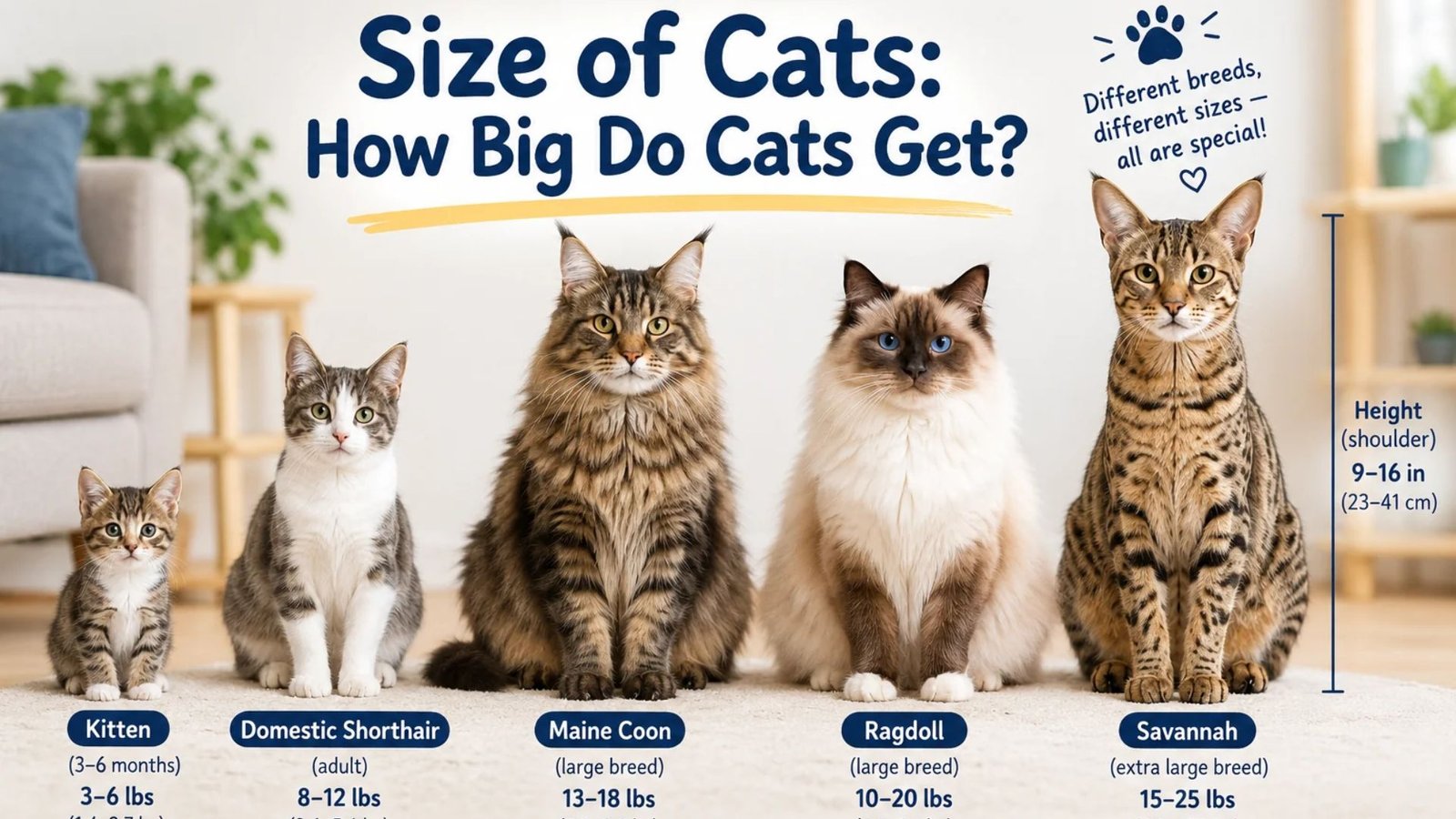
Cats come in many shapes and sizes. Some are small enough to curl comfortably in your lap, while others grow into large, muscular companions. If you are wondering about the size of cats, understanding their average weight, height, length, and growth stages can help you know whether your cat is developing normally.
A cat’s size depends on several factors, including breed, genetics, age, nutrition, and overall health. Domestic cats usually reach their adult size between 12 and 18 months, although some larger breeds continue growing for longer.
Whether you have a playful kitten, an adult house cat, or a large breed such as a Maine Coon, this guide explains what to expect at every stage of life.
Average Size of Cats
Most domestic cats are medium-sized animals. Although individual cats can be smaller or larger, many healthy adult domestic cats fall within a fairly predictable size range.
ALSO READ:How Do You Know If Cats Are Playing or Fighting?
Here are the typical measurements of an adult domestic cat:
| Measurement | Average range |
| Weight | 8–12 pounds (3.6–5.4 kg) |
| Body length | 15–20 inches (38–51 cm) |
| Shoulder height | 9–10 inches (23–25 cm) |
| Tail length | 10–12 inches (25–30 cm) |
| Lifespan | 12–18 years or longer |
These figures are general estimates, not strict health standards. A naturally small cat may be perfectly healthy at a lower weight, while a large-framed cat may weigh more without being overweight.
Your cat’s body condition is more important than comparing its measurements with another cat.
How Big Do Cats Get?
Most domestic cats reach their full adult body size between 12 and 18 months. However, their growth rate is not the same throughout their lives.
Kittens grow particularly quickly during their first six months. After that, their growth gradually slows down as their bodies develop.
Some large breeds, especially Maine Coons, can take three to four years to reach their full physical size.
A cat’s final size is influenced by:
- Genetics: Parents and breed characteristics influence body structure and growth potential.
- Nutrition: Balanced food supports healthy bone and muscle development.
- Age: Younger cats are still developing, while adults have generally reached their full size.
- Health: Certain illnesses and nutritional problems can affect normal growth.
- Sex: Male cats are often somewhat larger than females, although there are plenty of exceptions.
A healthy cat does not need to be large. Small and medium-sized cats can be just as strong, active, and healthy as bigger breeds.
Size of Cats by Age
Understanding how cats grow at different ages makes it easier to estimate their expected adult size.
Newborn Kittens: 0–2 Weeks
Newborn kittens are extremely small and delicate. Most weigh approximately 3–4 ounces (85–115 grams) at birth.
Their eyes are closed, their ears are folded, and they depend entirely on their mother for warmth, feeding, and protection.
During these first two weeks, kittens gain weight quickly. Regular feeding and a warm, safe environment are essential for healthy development.
Young Kittens: 3–8 Weeks
Kittens become much more active during this stage. Their eyes are open, their hearing improves, and they begin exploring their surroundings.
By eight weeks, many kittens weigh around 1.5–2 pounds (0.7–0.9 kg), although individual growth varies.
They also begin developing coordination, playing with littermates, and learning important social behaviors.
Growing Kittens: 2–6 Months
This is one of the fastest growth periods in a cat’s life.
Kittens develop stronger muscles, longer legs, and more defined body shapes. Their appetite usually increases because they need extra energy for development.
Many kittens weigh between 2 and 6 pounds during this period, depending on their age, genetics, and breed.
Adolescent Cats: 6–12 Months
At this age, cats begin looking more like smaller versions of adult cats.
Their bodies become longer, their muscles develop, and their growth gradually slows. Some cats may reach nearly their adult size before their first birthday.
However, their bodies may continue filling out after they reach their adult height and length.
Adult Cats: 12–18 Months
Most domestic cats reach their adult body size during this stage.
Their bones have largely finished growing, and their body shape becomes more established. Their weight should remain relatively stable when they receive appropriate nutrition and exercise.
Large breeds may need considerably longer to finish developing.
Average Size of Popular Cat Breeds
Not all cats have the same body structure. Some breeds are naturally small and lightweight, while others have broad chests, long bodies, and heavier bones.
Here is a comparison of several popular cat breeds.
| Cat breed | Typical adult weight |
| Maine Coon | 12–22 lb |
| Siamese | 5–12 lb |
| Persian | 7–14 lb |
| Bengal | 6–15 lb |
| Ragdoll | 10–20 lb |
| Abyssinian | 6–10 lb |
These are approximate breed ranges, not guaranteed adult weights. Individual cats can fall outside them.
Maine Coon
Maine Coons are among the largest domestic cat breeds. They have long bodies, broad chests, large paws, and thick coats.
Adult males commonly weigh around 18–22 pounds, while females are generally smaller. They also mature slowly and may take three to five years to reach their full size.
Despite their impressive appearance, Maine Coons are often known for their friendly and gentle personalities.
Siamese
Siamese cats have slim, athletic bodies, long legs, and relatively narrow faces. They usually weigh less than large breeds.
Their lightweight structure does not mean they are weak. Siamese cats are active, intelligent, and naturally athletic.
Persian
Persian cats have compact bodies, short legs, round faces, and thick coats. Their fur can make them look larger than they actually are.
They are generally medium-sized cats and often have a calm, relaxed temperament.
Bengal
Bengal cats have muscular bodies and distinctive spotted or marbled coats. Their athletic appearance comes from their strong muscles and active nature.
They need regular play and opportunities to climb, explore, and exercise.
Ragdoll
Ragdolls are large, fluffy cats with broad bodies and soft coats. Males are generally heavier than females.
Their long fur can make them appear even bigger, so checking their actual body condition is important.
Abyssinian
Abyssinians are usually smaller and lighter than Maine Coons and Ragdolls. They have lean bodies, long legs, and short coats.
They are energetic cats that enjoy climbing, exploring, and interactive games.
What Factors Affect the Size of Cats?
A cat’s adult size is not determined by one factor alone. Several things influence how large or small a cat becomes.
Genetics and Family History
Genetics plays an important role in determining a cat’s body size.
If both parents are large, their kittens may also develop larger bodies. Similarly, kittens from smaller parents may remain relatively petite.
However, genetics does not guarantee an exact adult weight.
Mixed-breed cats can be especially difficult to predict because their appearance and body structure may come from several different breeds.
Breed Characteristics
Different breeds have different natural body structures.
For example, a Maine Coon has a large frame, while a Siamese has a more slender appearance. A Persian has a compact body, whereas a Bengal has a muscular and athletic build.
This is why comparing every cat with the same weight chart can be misleading.
Nutrition and Feeding Habits
Proper nutrition supports healthy growth, strong muscles, and normal development.
Growing kittens need food formulated for their life stage. Adult cats need balanced nutrition that helps maintain a healthy body condition.
Overfeeding does not make a cat grow taller or develop a healthier frame. It can simply lead to excessive body fat.
Ask your veterinarian to recommend an appropriate feeding amount based on your cat’s age, weight, activity, and health.
Gender
Male cats are often larger and heavier than females of the same breed.
The difference is particularly noticeable in some large breeds. However, individual genetics and health also matter.
A female cat can be larger than a male cat, so gender should never be the only factor used to estimate adult size.
Health and Medical Conditions
Health problems during kittenhood can sometimes interfere with normal development.
Parasites, inadequate nutrition, chronic illness, and other medical issues may affect growth or body condition.
An adult cat that suddenly becomes thinner or heavier should also receive attention. Unexpected weight changes can sometimes indicate an underlying health problem.
How to Tell If Your Cat Has a Healthy Size
Knowing the number on a weighing scale is useful, but it does not tell the whole story.
Veterinarians often use a Body Condition Score (BCS) to assess whether a cat is underweight, at an ideal weight, or overweight.
You can perform a simple visual and physical check at home.
Check Your Cat’s Ribs
Gently run your hands along both sides of your cat’s chest.
You should be able to feel the ribs without pressing hard. A thin layer of fat should cover them.
If the ribs are extremely prominent, your cat may be underweight. If you struggle to feel them because of a thick fat layer, your cat may be overweight.
Look for a Visible Waist
Stand above your cat and look down toward its back.
A healthy cat generally has a slight inward curve behind the ribs.
If the body looks very round and there is no visible waist, excess body fat may be present.
Examine the Body from the Side
Look at your cat while it is standing naturally.
A healthy cat usually has a slight upward abdominal tuck behind the rib cage.
A rounded abdomen can indicate excess weight, although some cats naturally have a loose flap of skin called the primordial pouch. This pouch alone does not mean a cat is overweight.
Check Muscle Development
A healthy cat should have reasonably developed muscles around its shoulders, back, and hind legs.
Visible bones, significant muscle loss, or an unusually thin appearance may indicate a health concern.
Veterinary body-condition assessments are more reliable than appearance alone.
Small Cats vs. Large Cats: What Is the Difference?
Both small and large cats can make wonderful companions. Their differences are mainly related to body structure, activity needs, and sometimes care requirements.
| Feature | Small cats | Large cats |
| Body structure | Compact or slender | Broad or muscular |
| Weight | Usually lower | Usually higher |
| Space needs | Often easier to accommodate | May need larger beds and climbing spaces |
| Food needs | Depend on individual energy needs | May require more food, depending on activity |
| Exercise | Varies by personality | Varies by personality |
| Grooming | Depends on coat type | Depends on coat type |
A small cat does not necessarily need less attention, and a large cat does not automatically require more exercise.
Personality, age, health, and breed are just as important as body size.
Do Male and Female Cats Have Different Sizes?
Yes, male and female cats often have slightly different average body sizes.
Male cats commonly have:
- Broader heads and cheeks.
- Heavier bone structures.
- More muscular bodies.
- Greater average adult weight in many breeds.
Female cats are often:
- Slightly smaller in overall body size.
- Lighter in weight.
- More slender in some breeds.
These are general patterns rather than strict rules.
Neutering and spaying can also influence weight management because a cat’s energy requirements may change after the procedure. Food portions should be adjusted when necessary to prevent unwanted weight gain.
When Should You Be Concerned About Your Cat’s Size?
A cat being naturally small or large is not necessarily a problem. What matters is whether its body size is appropriate for its age, breed, and health.
You should consider veterinary advice if you notice:
- Your kitten is not gaining weight as expected.
- Your cat is losing weight without an obvious reason.
- Its ribs, spine, or hip bones become unusually prominent.
- Your cat develops a rapidly increasing belly.
- It becomes less active or stops eating normally.
- Its body shape changes noticeably over a short period.
Do not try to make an underweight cat gain weight through excessive feeding or put an overweight cat on a sudden restrictive diet.
A veterinarian can check for possible medical causes and recommend a safe feeding plan.
How to Measure Your Cat’s Size at Home
You do not need expensive equipment to measure your cat. A measuring tape and a weighing scale are usually enough.
Follow these simple steps:
Measure Body Length
- Let your cat stand naturally.
- Place the measuring tape near the base of the neck.
- Measure along the back to the base of the tail.
- Record the measurement in inches or centimetres.
Avoid including the tail when measuring body length.
Measure Shoulder Height
- Let your cat stand on a flat surface.
- Find the highest point of its shoulders.
- Measure vertically from the floor to that point.
- Keep the measuring tape straight.
Measure Body Weight
A pet scale is useful, but a regular household scale can also work.
- Weigh yourself first.
- Hold your cat and weigh yourself again.
- Subtract your weight from the combined weight.
For example, if you weigh 150 pounds and weigh 159 pounds while holding your cat, your cat weighs approximately 9 pounds.
Record measurements regularly so you can notice unusual changes.
Do Indoor and Outdoor Cats Have Different Sizes?
Indoor and outdoor cats do not automatically have different natural body sizes.
However, their lifestyles can influence their weight.
Indoor cats may have fewer opportunities to exercise, especially if they spend most of their time sleeping or relaxing. Without enough activity and appropriate food portions, they can gain excess weight.
Outdoor cats may get more movement through exploring, climbing, and hunting behaviors. However, outdoor activity does not guarantee a healthy weight.
Both indoor and outdoor cats need:
- Balanced meals.
- Fresh drinking water.
- Regular physical activity.
- Appropriate veterinary care.
- A healthy body-condition score.
Interactive toys, climbing trees, scratching posts, and daily play sessions can help indoor cats stay active.
How to Help Your Cat Maintain a Healthy Size
Maintaining a healthy body size is important for your cat’s long-term well-being.
Here are some practical ways to support your cat.
Provide balanced food: Choose complete and balanced cat food appropriate for your cat’s age and health needs.
Control portion sizes: Measure food instead of constantly filling the bowl. Follow feeding recommendations and adjust portions with veterinary guidance.
Encourage daily play: Use feather toys, balls, tunnels, and interactive games to encourage movement.
Monitor weight: Weigh your cat regularly and keep a record of changes.
Schedule veterinary checkups: Routine examinations help identify weight-related problems and other health concerns early.
Avoid excessive treats: Treats should make up only a small portion of daily calories. Too many can contribute to unwanted weight gain.
Remember that maintaining a healthy size is about keeping your cat fit, not making it as big or small as possible.
Conclusion
The size of cats varies depending on breed, genetics, age, nutrition, and overall health. Most domestic cats are medium-sized, but some breeds, such as Maine Coons, can grow considerably larger than average.
While many domestic cats reach their adult body size during their first 12–18 months, larger breeds may continue developing for several years.
Instead of focusing only on weight or measurements, pay attention to your cat’s body condition, activity, appetite, and general health. Regular veterinary checkups and balanced nutrition can help your feline companion maintain a healthy size throughout life.
ALSO READ:Early Signs of a Pregnant Cat: 10 Signs to Watch For
FAQs
What is the average size of a domestic cat?
Most domestic cats are medium-sized, with many healthy adults weighing around 8–12 pounds. Their actual ideal weight depends on their body frame and breed.
At what age do cats reach their full size?
Many domestic cats reach adult size between 12 and 18 months. Larger breeds, such as Maine Coons, may continue growing until three to five years.
Which domestic cat breed is the largest?
The Maine Coon is one of the largest recognized domestic cat breeds. Adult males commonly weigh around 18–22 pounds.
Are male cats bigger than female cats?
Generally, male cats are somewhat larger and heavier than females of the same breed. However, genetics and individual body structure can create exceptions.
How can I tell if my cat is overweight?
Check whether you can feel its ribs, see a slight waist from above, and notice an upward abdominal tuck from the side. A veterinarian can confirm its body condition.
Related Post

Best Male Cat Names: 150+ Ideas for Your New Cat
Choosing a name for your male cat is one of the most enjoyable parts of [...]
Cat Trembling: Causes, Warning Signs, and What to Do
Cat trembling can be worrying, especially when your cat suddenly starts shaking without an obvious [...]